Language Guides Updated 2026-09-13 6 min read KindLearn Team
How to List Language Skills on a Resume: CEFR Levels Explained
How to list a language on your resume or CV: the six CEFR levels, LinkedIn’s five labels, sample lines, and what a 30-day beginner course really gives you.
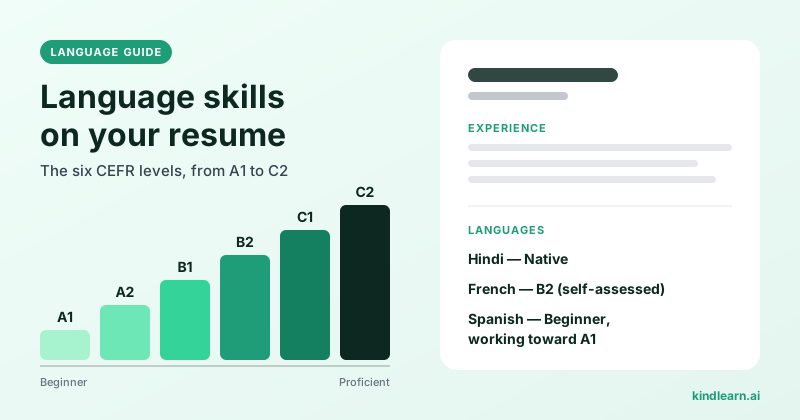
Listing a language on your resume is easy. Listing it so a recruiter knows exactly what you can do takes one more step: a level on a scale they recognize. This guide explains the CEFR, the six-level scale used across Europe and by many employers worldwide, the five labels LinkedIn uses, and how to describe a language you have only just started learning without overstating it.
Where languages go on a resume
Give languages their own short "Languages" section. If you only have one language besides your native one, a line in your "Skills" section is enough. Either way, use one line per language, in the same form every time:
- Language — level (scale, how you know)
Put your native language or languages first, then the rest from strongest to weakest. Keep it short: a recruiter should be able to read the whole section in a couple of seconds.
The CEFR levels, A1 to C2
The Common European Framework of Reference for Languages (CEFR) comes from the Council of Europe and was published in 2001. It describes language ability in six levels, grouped in pairs. In plain English:
- A1 — Beginner. You understand and use familiar everyday expressions and very basic phrases. You can introduce yourself and ask and answer simple questions about personal details, if the other person speaks slowly and helps.
- A2 — Elementary. You handle simple, routine exchanges on familiar topics, such as shopping, work basics and your local area.
- B1 — Intermediate. You understand the main points on familiar matters and can deal with most situations that come up while traveling.
- B2 — Upper intermediate. You interact with a degree of fluency and spontaneity, and can explain a viewpoint on a wide range of topics.
- C1 — Advanced. You express yourself fluently and spontaneously without obvious searching for words, including at work or in study.
- C2 — Proficient. You understand virtually everything you hear or read and express yourself precisely, with ease.
The Council of Europe publishes the full CEFR level descriptions if you want the official wording.
Rate yourself on five skills, not one
The Europass self-assessment grid splits a language into five skills: listening, reading, spoken interaction, spoken production and writing. Many people are a level higher at reading than at speaking, and that is normal.
If your levels differ, either list the lower one or split the line, for example "German — B1 reading, A2 speaking". The Europass CEFR page walks through each skill level by level, which makes an honest self-rating much easier.
LinkedIn's five proficiency labels
LinkedIn does not use CEFR letters. When you add a language to your profile, it asks you to pick one of five labels:
- Elementary proficiency
- Limited working proficiency
- Professional working proficiency
- Full professional proficiency
- Native or bilingual proficiency
LinkedIn does not publish an official CEFR equivalent for these, so choose the label your self-assessment supports. On the resume itself, prefer the CEFR letter wherever a recruiter will know it.
Self-assessed or certified: say which
An exam certificate is stronger evidence than a self-rating. If you have one, name the certificate and the year, for example "DELE B2" for Spanish, "DELF B1" for French or "Goethe-Zertifikat A2" for German. If you do not, write "(self-assessed)". Either is fine, as long as the reader can tell which it is.
Be ready to back it up. For roles that use the language, interviewers may switch to it for a few minutes to check.
Example lines you can copy
- Hindi — Native
- English — C1 (IELTS, 2025)
- French — B2 (self-assessed)
- Spanish — Beginner, working toward A1 (self-assessed)
What a 30-day KindLearn course gives you, honestly
Each of KindLearn's 13 language courses runs 30 days at 10 new items a day, introducing roughly 300 distinct words. At about fifteen minutes a day, that is about seven hours of study. That is the foundation of CEFR A1, not the whole of it, and it is not conversational fluency. A1 itself is usually estimated at 80–100 guided hours, so finishing the course does not make you B1, or even A2.
The honest resume line after the course is "Spanish — Beginner, working toward A1". It still shows an employer that you started and stuck with it.
If you want to start, start a free 30-day course in any of the 13 languages. To keep building your speaking toward A1, use AI conversation practice — 60 messages a day when signed in, 5 as a visitor. For a routine around the course, our 30-day Spanish study plan shows how to structure the month, the free 30-day Spanish course publishes every day's words, and our ranking of the best free language learning apps of 2026 covers other tools.
Should you list a language you are still learning?
Yes, if the role values it and you label the level honestly. No, if you could not handle a basic exchange about yourself in an interview. Either way, update the line as your level grows.
Building the rest of your resume
For the rest of the document, KCF LLC, the company that builds KindLearn, also makes Kindyra, a free AI resume builder.
Frequently asked questions about language skills on a resume
What CEFR level is conversational?
B1 is where the CEFR describes handling most everyday and travel situations. B2 adds fluency and spontaneity, which is usually what employers mean by "conversational" for work.
Can I put A1 on my resume?
Yes, labeled honestly. It signals that you have started, not that you can work in the language.
Do I need a certificate to list a CEFR level?
No. Write "(self-assessed)" after the level. If you have a certificate, name it and the year instead.
How do I list my native language?
Write "Native" after it, and list it first.
Does finishing KindLearn's 30-day course give me a CEFR level?
No. It lays the foundation of A1. The completion certificate records the roughly 300 words you met, not a level.